THE DREAMER
Allama Muhammad Iqbal
1877 – 1938 · MUFAKKIR-E-PAKISTAN
شاعرِ مشرق — The Poet of the East
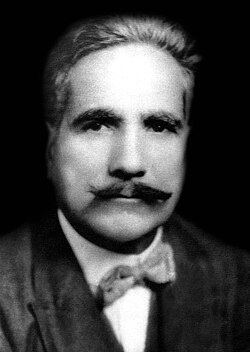
QUICK INFORMATION
- FULL NAME
- Muhammad Iqbal
- BORN
- 9 November 1877, Sialkot
- DIED
- 21 April 1938, Lahore
- EDUCATION
- PhD (Munich), Cambridge, Heidelberg
- PROFESSION
- Poet, Philosopher, Barrister
- LANGUAGES
- Urdu, Persian, English, Arabic
- SPOUSE
- Karim Bibi, Sardar Begum
- CHILDREN
- Javid Iqbal (son)
- NATIONAL TITLE
- Poet of the East / شاعرِ مشرق
- KNIGHTED
- Sir Muhammad Iqbal (1922)
- RESTING PLACE
- Iqbal's Mausoleum, Lahore
BIOGRAPHY
Allama Muhammad Iqbal (9 November 1877 – 21 April 1938) was a South Asian Muslim writer, philosopher, and politician, whose poetry in Urdu and Persian is considered among the greatest of the modern era. He is officially recognized as the national poet of Pakistan and is widely regarded as the Spiritual Father of Pakistan for inspiring the Pakistan Movement through his philosophical works and visionary poetry.
Born in Sialkot, Punjab, to a Kashmiri family, Iqbal received his early education in his hometown before moving to Lahore for higher studies. He graduated from Government College Lahore, then traveled to Europe where he studied at Cambridge, Munich, and Heidelberg, earning his PhD from Munich University in 1908 with a thesis on Persian metaphysics.
Upon returning to India, Iqbal practiced law but his true passion remained poetry and philosophy. Through his works, he sought to awaken the Muslim world from its slumber and inspired a generation of Muslims to strive for self-determination and spiritual revival.
Philosophical Legacy
IN HIS OWN WORDS
Immortal Poetry
لب پہ آتی ہے دعا بن کے تمنا میری زندگی شمع کی صورت ہو خدایا میری
A prayer rises to my lips as a wish, O Lord, May my life be like a candle that illuminates others.
خودی کو کر بلند اتنا کہ ہر تقدیر سے پہلے خدا بندے سے خود پوچھے بتا تیری رضا کیا ہے
Elevate your selfhood so high that before every decree, God Himself asks the human: 'Tell me, what is your wish?'
ستاروں سے آگے جہاں اور بھی ہیں ابھی عشق کے امتحاں اور بھی ہیں
Beyond the stars, there are still more worlds, The tests of love are still more to come.
IN THEIR WORDS
Words of Wisdom
“Nations are born in the hearts of poets, they prosper and die in the hands of politicians.
“The ultimate aim of the ego is not to see something, but to be something.
“Islam is itself destiny and will not suffer destiny.
THE PHILOSOPHY
Key Philosophical Concepts
Khudi (Selfhood)
The development and strengthening of the individual ego/self as the highest spiritual goal. Iqbal saw khudi as the source of all creative energy and achievement.
Mard-e-Momin (The Perfect Man)
The ideal Muslim who has fully developed his khudi and lives in harmony with God's will while actively shaping the world.
Shaheen (The Eagle)
A metaphor for the ideal Muslim who soars high above worldly concerns, maintains independence, and lives with dignity.
Ijtihad
The principle of independent reasoning in Islamic law to address modern challenges while maintaining fidelity to core principles.
THE LIBRARY
Major Literary Works
THE JOURNEY
Life Timeline
- 1877
Born in Sialkot on 9 November to a Kashmiri family.
- 1895
Graduated from Scotch Mission College, Sialkot.
- 1899
Completed MA in Philosophy from Government College Lahore.
- 1905
Traveled to Europe for higher education.
- 1908
Awarded PhD from Munich University; called to the bar at Lincoln's Inn.
- 1915
Published 'Asrar-e-Khudi' (Secrets of the Self) in Persian.
- 1922
Knighted by King George V for literary achievements.
- 1924
Published 'Bang-e-Dra' — collection of Urdu poetry.
- 1930
Delivered historic Allahabad Address proposing separate Muslim state.
- 1932
Participated in Third Round Table Conference in London.
- 1938
Passed away in Lahore on 21 April; buried near Badshahi Mosque.
THE RECORD
Landmark Achievements
Spiritual Father of Pakistan
His Allahabad Address (1930) provided the intellectual foundation for the creation of Pakistan, inspiring the Two-Nation Theory.
Reconstruction of Islamic Thought
His lectures published as "The Reconstruction of Religious Thought in Islam" remain a seminal work in modern Islamic philosophy.
National Poet
Officially recognized as Pakistan's national poet; his poetry continues to inspire generations across the Muslim world.
Academic Excellence
First Muslim to earn a PhD in philosophy from a European university, bridging Eastern and Western thought.
Literary Legacy
Produced an unparalleled body of poetry and prose in Urdu, Persian, and English that transformed Islamic literature.
Legal Career
Distinguished barrister who practiced law while pursuing his philosophical and literary work.
THE IMPRINT
Legacy & Impact
Allama Iqbal's influence extends far beyond the borders of Pakistan. His philosophical works have inspired Muslim revival movements across the world, from the Middle East to Southeast Asia. In Pakistan, his birthday (9 November) is celebrated as Iqbal Day, and his mausoleum in Lahore is a national monument visited by millions.
Iqbal's vision of Khudi (self-actualization) continues to inspire young Muslims to strive for excellence while maintaining their spiritual identity. His poetry is taught in schools and universities, quoted in political speeches, and recited in cultural gatherings. His message of unity, faith, and discipline — later adopted as Pakistan's national motto — remains as relevant today as it was during the freedom movement.
Internationally, Iqbal is recognized alongside Rumi and Hafez as one of the greatest poet-philosophers of the Islamic world. His works have been translated into dozens of languages, and academic centers dedicated to his thought exist in universities across the globe.
12+ Major Collections
POETIC WORKS
Persian, Urdu, English
LANGUAGES
40+ Languages
TRANSLATIONS
20th–21st Century
CENTURIES STUDIED
100+ Worldwide
INSTITUTIONS NAMED
Iqbal Day (Nov 9)
ANNUAL COMMEMORATION
نہیں ہے نا امید اقبال اپنی کشتِ ویراں سے ذرا نم ہو تو یہ مٹی بڑی زرخیز ہے
Iqbal is not hopeless from his barren land — if it gets a little moist, this soil is very fertile.
— Allama Iqbal