
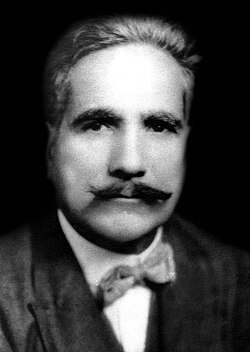

Allama Iqbal – The Spiritual Architect of Pakistan
When we speak of the creation of Pakistan, we often think of the political struggle, the negotiations, and the eventual independence. But behind every great movement lies a powerful idea. And the idea behind Pakistan was born in the heart and mind of one man: Allama Muhammad Iqbal.
Known as the “Poet of the East” (شاعر مشرق) and the “Spiritual Father of Pakistan,” Iqbal did not merely write poetry. He ignited a revolution of thought. He awakened the Muslims of South Asia from a deep slumber and gave them a vision of hope, honor, and a homeland of their own.
Let us explore the life, philosophy, and enduring legacy of this extraordinary thinker.
From Sialkot to the World – The Making of a Visionary

Muhammad Iqbal was born on November 9, 1877, in Sialkot, Punjab (now in Pakistan). From a young age, he showed a deep love for learning, poetry, and philosophy. His early education in Sialkot was followed by higher studies at Government College Lahore, where he graduated with a Master’s degree in Philosophy.
But Iqbal’s thirst for knowledge was limitless. He traveled to England and Germany, studying at Cambridge, Heidelberg, and Munich. In 1908, he earned his PhD from Munich University with a thesis on Persian metaphysics. This blend of Eastern wisdom and Western education gave him a unique perspective that would later shape his revolutionary ideas.
📖 Did You Know? Iqbal was the first Muslim to earn a PhD in philosophy from a European university, bridging the gap between Eastern and Western thought.
Khudi (Selfhood) – The Core of Iqbal’s Philosophy

At the heart of Iqbal’s philosophy is the concept of “Khudi” (Selfhood). For Iqbal, every human being has an inner self that can be developed, strengthened, and elevated. A person with strong Khudi is confident, courageous, and capable of shaping their own destiny.
In his famous Persian work “Asrar-e-Khudi” (Secrets of the Self), Iqbal explains that the ultimate goal of life is to realize and strengthen one’s self. This is not selfishness—it is self-actualization. When individuals strengthen their Khudi, they contribute to the strength of their community and nation.
خودی کو کر بلند اتنا کہ ہر تقدیر سے پہلے
خدا بندے سے خود پوچھے بتا تیری رضا کیا ہے
“Elevate your selfhood so high that before every decree, God Himself asks: ‘Tell me, what is your wish?'”
The Historic Allahabad Address (1930)

On December 29, 1930, at the annual session of the All-India Muslim League in Allahabad, Iqbal delivered a speech that would change the course of history. In this address, he first proposed the idea of a separate Muslim state in the northwestern regions of South Asia.
He argued that Muslims were a distinct nation with their own identity, culture, and religion. They could not thrive in a Hindu-majority India. This was the foundation of the Two-Nation Theory that later became the ideological basis for Pakistan.
🇵🇰 Historical Impact: Jinnah himself said that Iqbal was the first to clearly articulate the idea of a separate homeland for Muslims, and he worked tirelessly to turn that vision into reality.
The Poet Who Awakened a Nation
Iqbal’s poetry is not merely beautiful—it is powerful, revolutionary, and deeply inspiring. He wrote in both Persian and Urdu, addressing themes of self-respect, justice, courage, and faith. His works include:
- Bang-e-Dra (The Call of the Bell) – 1924
- Bal-e-Jibril (Gabriel’s Wing) – 1935
- Zarb-e-Kalim (The Rod of Moses) – 1936
- Javid Nama (The Book of Eternity) – 1932
- The Reconstruction of Religious Thought in Islam – 1930 (his famous philosophical lectures)

The Eternal Legacy of Allama Iqbal
Allama Iqbal passed away on April 21, 1938, less than a decade before Pakistan’s independence. He did not live to see the country he dreamed of, but his spirit and vision guided the struggle every step of the way.
Today, Iqbal is officially recognized as Pakistan’s national poet. His birthday, November 9th, is celebrated as Iqbal Day across the country. His mausoleum in Lahore, near the Badshahi Mosque, is a place of pilgrimage for millions who come to pay their respects.
His message of self-respect, hard work, courage, and faith is as relevant today as it was a century ago. For the youth of Pakistan, Iqbal remains a beacon of hope and a reminder that they have the power to shape their own destiny.
نہیں ہے نا امید اقبال اپنی کشت ویراں سے
ذرا نم ہو تو یہ مٹی بڑی زرخیز ہے
“Iqbal is not hopeless from his barren land. If it gets a little moisture, this soil is very fertile.”
Allama Iqbal did not just give us poetry. He gave us pride, purpose, and a vision. As we build the future of Pakistan, let us keep his words in our hearts and his spirit in our actions.
🇵🇰 Pakistan Zindabad! 🇵🇰